History
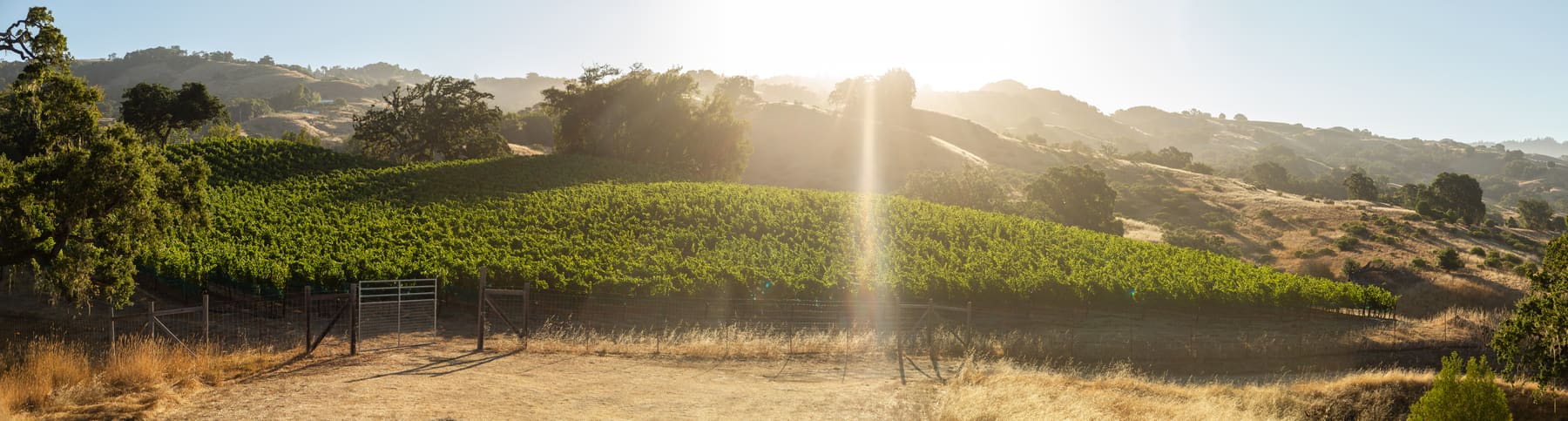
Fathers & Daughters in summer grassFor most of the modern history of The Anderson Valley, what is now Ferrington Vineyards existed as part of a larger sheep ranch, a subdivision of which Balverne Cellars acquired and began planting in 1969. A detailed timeline of its development, the people who shaped it, and the winemakers who brought it to prominence can be found below.
-
1890
The first Italian immigrant families plant small vineyards.
-
1911
The Pinoli family establishes the first bonded winery in Anderson Valley.
-
1940s
Italian Swiss Colony plants vineyards with French Colombard and Ugni Blanc for table wine production. These varietals perform poorly.
-
1963
Dr. Donald Edmeades plants Cabernet Sauvignon, Gewürztraminer, Pinot Noir, and Chardonnay. The Cabernet fails while the other three thrive.
-
1967
Dony and Gretchen Husch found Husch Vineyards, producing Anderson Valley's first commercial vintage in 1971.
-
1969
Hans and Theresia Kobler take over Lazy Creek Vineyards from the Pinoli family, introducing European suitcase clones and establishing the valley's second commercial winery.
-
1969
Balverne Cellars plants what is now the 'A' block of Ferrington Vineyard on what had been a subdivision of the Ricard Sheep Ranch. A small block of old-vine, cool climate Sauvignon Blanc remains at Block A-1.
-
1972
Brad Wiley begins planting Wiley Vineyard, establishing the Deep End of the Anderson Valley as a source for high quality Pinot Noir.
-
1973
Ted Bennett and Deborah Cahn begin farming winegrapes before founding Navarro Vineyards in 1974. They were among the first commercial wingrowers, and the first to open a purpose-built tasting room, setting a style and standard for the valley that continues to today.
-
1970s
Dr. Richard Ferrington acquires Ferrington vineyard from Balverne Cellars.
-
1980s
John Thomas Ferrington develops a love, reputation, and affinity for Pinot Noir. He brings Burgundy budwood cuttings from grand cru vineyards in Montpellier and plants them on the toe of a slope on the eastern edge of what is now Ferrington block B.
-
1992
Cult winemaker Burt Williams from Williams Selyem establishes a relationship with John Thomas Ferrington, and begins sourcing fruit for their first vintage of vineyard designated Ferrington Pinot Noir.
-
1991
Rich Savoy, owner of San Francisco's Green Apple Books, plants his eponymous vineyard with a mixture of Pinot Noir and Chardonnay.
-
1995
Ted Lemon of Littorai Wines sources fruit for his first vintage of vineyard designated Savoy Pinot Noir.
-
1996
Kurt Schoeneman purchases Ferrington Vineyards from Dr. Ferrington, beginning a major restoration and replanting supervised by Norman Kobler.
-
2001
John Ferrington passes away; The John Ferrington Scholarship is later established at UC Davis in his memory.
-
2004
Arista Winery's first vintage of vineyard designated Ferrington Pinot Noir.
-
2005
James MacPhail sources his first vintage of Ferrington Pinot Noir.
-
2007
Black Kite Cellars sources its first vintage of Ferrington Pinot Noir.
-
2009
Hugh Davies of Davies Vineyards sources its first vintage of Ferrington Pinot Noir.
-
2020
Matt & Alexis Iaconis produce their first vintage of Ferrington Chardonnay.
-
2025
Kelsey Phelps of Seppi Wines sources Pinot Noir and Chardonnay for the first single-vineyard Ferrington sparkling wine.
-
2025
Kurt Schoeneman passes, in his sleep, at the vineyard he so loved, passing responsibility for it to his children Sarah, Doug, and Fred.